

Showing posts with label cookbook reviews. Show all posts
Showing posts with label cookbook reviews. Show all posts
Tuesday, October 20, 2009


Saturday, April 12, 2008
Nigella Express
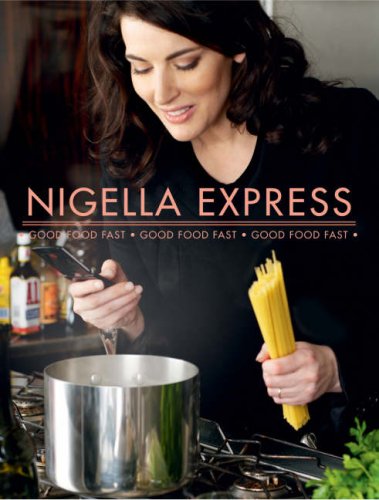
Have already made the linguini with lemon, mushrooms, garlic and thyme: very express and very delicious. Recipe coming.
Sunday, March 23, 2008
Riverbend Books at Balmoral, plus German cooking

Especially, Riverbend has great cookbooks, and books on cooking. There is a book out called Eating For England that I really want to buy: it is filled with funny anecdotes and information about those quintessential British foods and dishes like spotted dick and Cadbur
The other book that I bought today is called Culinaria Germany. It's one of a series that also includes Russia and Hungary. I had to get it, because it's not often you see a giant cookbook busting its seams with information about German food and cooking.
I don't really know much about German cooking. My knowledge is confined to a few thematic cooking moments at home, a visit to the Black Forest German Cafe-Restaurant at West End for Oktoberfest last year, and a fleeting 3-day visit in 2004 to see my friend and her family, who live in the shipbuilding town of Papenburg in Lower Saxony. (We also visited the Becks factory in Bremen: what an afternoon that was!)
My friend's mother made us a special meal: I don't remember much except the spatzle and the rich cakey dessert. Breakfast was a platter of cold meats, soft dark bread, smooth mild cheeses like emmenthal and gruyere, and lots of hot milky coffee.
Saturday, January 12, 2008
Apple and ginger tart
Made this last night: friend came round for simple Sunday night dinner. I was wondering what to cook, and possibly as a result of reading too much Elizabeth David (new series starting on the ABC tonight: all about her life and times) and Simon Hopkinson and watching Rick Stein's Mediterranean Escapes show on cable, I regressed back to French. Easy, worry-free, comforting.
The main was some pieces of juicy rump that the Annerley butcher cut for me. I marinated them for a few hours in a tiny bit of peanut oil and some slivers of garlic, to add flavour. No salt at all. With that we served these potatoes (AGAIN...but they're so good!) except this time, I added some baby brown onions, peeled, omitted the garlic, and added a sprinkle each of sugar and salt. The onions caramelised up really well and added their flavour to the potatoes. I served a salad separately. It had baby spinach, watercress, butter lettuce, radish and Lebanese cucumber in it with a light vinaigrette dressing.
Afterwards we had this simple apple and ginger tart. In retrospect, I should have had the oven on hotter: the pastry didn't crisp evenly and I was a bit unimpressed with that. However, I thought the tart itself was sound. Worth making again.
Apple and ginger tart
- 3 big green apples
- One thumb of new (pink) ginger, grated (or the same of old, but use more and peel it first)
- 1 cup sugar
- Frozen puff pastry ( I used half of one sheet)
- Apple schnapps or cognac, about 2 tablespoons
Peel and slice the apples so that they form half-moon shapes. Put them into a saucepan with the grated ginger and just cover with water. Add the sugar and bring to the boil: poach the apples for one minute. Lift out the apples and set aside. Drain the syrup to remove the ginger. Put the drained syrup back on the heat: add the schnapps. Boil and reduce to a medium syrup: not too dark or thick though. Let it cool. Pour it back over the apples. At this point you could store the syrupy apples in the fridge until you decide to make the tart.
Preheat oven to 200C. Lay a sheet of puff pastry on baking paper on a baking tray. Arrange the slices however you like. I do mine in two little overlapping rows. Paint the apples with a bit of the syrup. Bake the tart for about twenty minutes or half an hour, until the pastry is puffed and golden to your liking. Brush a little more syrup over before serving, or just hand the syrup round in a jug.
I served mine with slightly sweetened whipped cream, flavoured with maple syrup. If I did this again I would lose the syrup and the whipping. I would have the cream plain in a bowl nearby.
Jamie Oliver's lamb shoulder with noodles, baby spinach and mint caper gravy
 In his new book, Jamie At Home (which is truly great, by the way: not one dud recipe in there), in the lamb chapter, there's a recipe for slow-roasted shoulder of lamb with smashed vegetables and some wilted greens. Mum had a go at the shoulder, using a boned rolled leg, flattened out. (The butcher was being difficult: we'll deal with him later.) She put it in a baking dish with unpeeled garlic cloves, rosemary and a tiny bit of olive oil and salt, and roasted it with a tight lid of tinfoil for a few hours at a low heat. It was perfect: melting, falling apart, heaps of flavour and still juicy.
I took a piece of it home to play with: it ended up as a homage to Jamie, and using the same sauce he recommends in the book.
We cooked some of that curly wide pasta (not lasagne sheets, ricciarelle) until just before al dente. It was dressed with some unsalted butter and went into a bowl with baby spinach leaves. We tossed them together to slightly wilt the leaves. Over the top went the shredded lamb pieces. The sauce is a mixture of the lamb juices from the roasting, light chicken stock, capers and red wine vinegar. I heated all these together in a pan and used a little flour to thicken. The sauce went over the lamb and sprinkled on top were some torn fresh mint leaves.
It was really delicious. Probably not what Jamie originally has in mind, but definitely a testament to what you can do with a few simple ingredients and easy slow cooking.

Later we cooked the REAL roast shoulder, with steamed squash, broccolini, carrot, beans and roast kipfler potatoes.  Big success.
 Big success.
Friday, May 25, 2007
Verdict: Classic Pasta Cookbook by Giuliano Hazan

Ah, Giuliano. How you have sustained me through those long hours of kneading and rolling fresh pasta dough. This is his first cookbook effort: he's the son of the famous and infamous Marcella Hazan, she of 1973's The Classic Italian Cookbook and the bringing-Italian-to-the-masses routine. She has a little foreword in here, talking about his incredible pasta-eating prowess as an infant and how she's so proud of him carrying on the tradition and so on. The book is fully illustrated: full-colour full-page photos of every dish and ingredient, and of him beaming like a plump little owl as he poses artfully with his wooden spoon poised over a giant steaming dish of tagliatelle.
Actually, he looks like a total super-nerd: like someone who should be arguing on Usenet about the technical benefits of coding in C++ over Java while sucking back coffee with four sugars and listening to the DVD commentary on season 15 of The Simpsons.
But it seems that looking like an egghead does not preclude one from writing an awesome pasta book. And with such a culinary pedigree, you'd have to be concerned if it wasn't awesome.
But it seems that looking like an egghead does not preclude one from writing an awesome pasta book. And with such a culinary pedigree, you'd have to be concerned if it wasn't awesome.
Most-cooked recipe: Without a doubt, the ragu on page 62. Here's my recipe: my morphed from-memory approximation of a recipe I've made dozens and dozens of times. It truly is incredible, and has become an absolute family favourite. When I first read it, I was a little perplexed by his inclusions of nutmeg and milk, but am now a convert. Giuli knows what he's on about. Also, his classic sauces arrabiata and puttanesca ('angry' pasta and 'whore's' pasta..!) are my two favourite pasta sauces, and they have been made quite a few times.
When we lived in Port Moresby, there was this creepy little pasta and pizza joint called The Spaghetti House that we used to go to quite often. You had to go into a gated compound and then up some rickety old exterior stairs to get in there, but once in it was like Little Italy meets Melanesia. Red checkered tablecloths, lame accordion music, the lot. This joint made the absolute best pasta arrabiata that we've ever had. Mum in particular was nuts about it. We tried many a time to recreate this arrabiata at home, but to no avail. (Theirs probably got its flavour from using mouldy old saucepans or MSG or something). Anyway, we should have asked them for the recipe. Seeing as we didn't and they've now closed down, Giuli's arrabiata has come the closest yet to that delicious ideal...
And obviously, fresh pasta, which I learned how to make from this book.
Recipe I haven't tried, but it was one of the reasons I bought the book: Carbonara, spaghetti al cognac, trenette with walnut pesto.
Rejected recipe: Oh Giuli, I could never reject anything you've made. Except, maybe, the tortelloni stuffed with Swiss chard. I am one of those people who finds it challenging to eat anything from the spinach-and-ricotta food group. Spanakopita: urgh. It's the texture of the ricotta that does it.
General good things: The book is divided into sections: an illustrated catalogue of different pasta types and shapes, a how-to on making it from scratch, a dozen or so classic sauces, then a huge selection of recipes, then a how-to on chopping up vegies for pasta and a guide as to what should be in your storecupboard. This would be great for a beginner, as it shows everything in filthy detail: each step, each ingredient, while explaining along the way in a kind friendly pasta-nerd voice.
General bad things: Nope. Completely, unselfconsciously helpful and explanatory in every way, without being condescending. Plus his giant round glasses are really fun to look at while you cook.
Lameness factor: High. The endless photos... the I'm-cooking-with-Mummy routine...
Overall rating(from 20): 19.5. I really love this book, but I have to take off half a point for the serial-killer expression on his face on page 9.
Sunday, December 31, 2006
Verdict: Feast by Nigella Lawson
Here it is, her most-latest (and in my opinion, the best) of her cookbooks. I was given this for Christmas 2005 and so far, it's been Very Helpful, not only in the recipe department, but also in providing general information about worldwide holidays, traditions and religions. Interesting.
There were a couple of different covers printed for this, and I'm so glad I have the one I have. The alternate covers feature her in a red jumper looking inane, and the word Feast is in very non-feasty font and also has a weird placement. I probably wouldn't be so happy with this book if it had a different cover. Shallow? Mmm, probably.
Most-cooked recipe: The Green Bean and Lemon Casserole on page 33 (Christmas section). It ain't no casserole, it's just beans, butter, lemon and salt, but we cook it All The Time (really, at least once a week) and it has become a real favourite. We do it with Greek-style lamb chops (garlic, rosemary and yoghurt on the side) or with pork. The lemon really cuts through the rich meat. The Chocolate Malteser Cake also has been given a workout, I must admit. Many recipes from this year's birthday dinners have come from or been inspired by this book, including the Aromatic Lamb Meatballs on page 441 and the Lemon Roast Chicken with Lazy Mash.
Recipe I haven't tried, but it was one of the reasons I bought the book: Pretty much everything. It's all so incredibly rich, lush and fabulous-looking that if I read this for too long, I have sudden urges to rush to the shops, pick up some gear and cook us up a Major Feast...
I'd really like to try the keema, the kedgeree, the lokshen pudding, the baked sweet potato with marshmallows, the Nana's hachapuri, the honeyed almond and orange cake with figs, the stuffed roast leg of lamb, roast quinces with pomegranate seeds and the cardamom chicken. Quite a list. She gets so chatty that you feel as if none of it would be too taxing, and it's very easy to choose something great from such an extensive, far-reaching and comprehensive recipe collection.
Rejected recipe: I looked long and hard and honestly can't find anything to reject. All is great, all is good.
General good things: The breaking-down of the recipes into sections is excellent, as is dividing them by occasion rather than meal order. At first I was a little perturbed by the inclusion of Funeral Feasts, but then I thought, well, if I ever have to cater for a funeral, I'll know where to turn. The feast sections are appropriately multicultural and inclusive and have made me want to know more about some of these special occasions from other cultures.

- Thanksgiving and Christmas
- New Year
- Meatless Feasts
- Valentine's Day
- Easter
- Passover
- Breakfast
- Kitchen Feasts
- Kiddiefeast
- Cut-Out Cookies
- Chocolate Cake Hall of Fame
- A Georgian Feast
- Eid
- Ultimate Feasts
- Hallowe'en
- Rosh Hashanah
- A Venetian Feast
- Festival of Lights
- Partytime
- Midnight Feast
- Wedding Feast
- Funeral Feast
General bad things: She always gives measurements by weight, not by cup sizes. I KNOW that this is the proper way to do it, but it STILL annoys me because I just want to get on with it, not get out the scales, find the scale container, measure out annoyingly weency amounts of stuff, scrape out, weigh again, blah blah blah, wipe down the scales, etc. I'd rather just pour everything into a cup and then start cooking. Obviously also, a lot of stuff is sometimes not so easy for us to find in Brisbane as it is for her in the UK. Pomegranates? Sprue? Mangetout? Give some options, please, don't make me have to go looking up definitions and culinary substitutes for foreign ingredients.
Lameness factor: Maybe a 1, just for the homey girly guilty tone she seems to cultivate sometimes. Nigella, don't get all confessional about loving deep-fried and alcoholic treats- everyone feels like that sometimes and your readers aren't going to give a fig.
Overall rating(from 20): Yep, 20.
Tuesday, October 17, 2006
Kaikai Aniani: A Guide to Bush Foods, Markets and Culinary Arts of Papua New Guinea
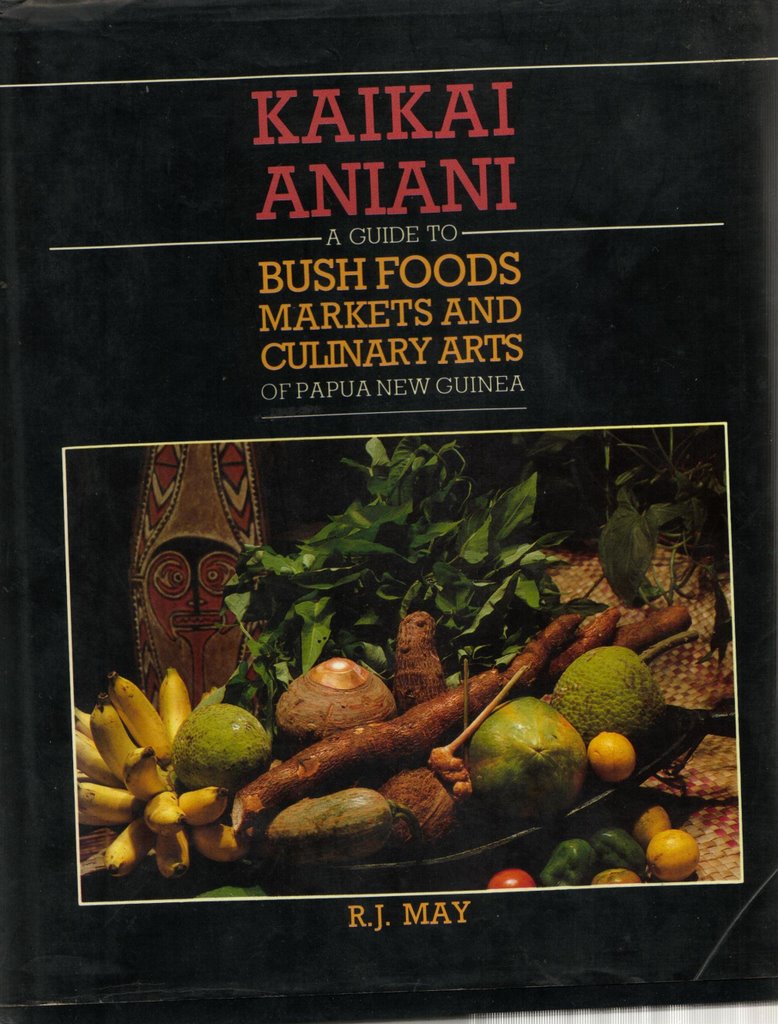
Written by R.J. May, first published in 1984.
This is really a great cookbook. Informative to the point of "thanks for sharing", chockers full of faintly-normal-sounding recipes that you could probably make a good go of if you wanted to, and with entire sections devoted to things like "Furry (and Spiney) Edible Animals" and "Traditional Stimulants". The recipes are very simple, homely, designed for expats living far from home and who need to adapt local ingredients to suit their western palates. The book is more concerned with telling readers what to do to make the local foods more appealing, rather than providing any sort of traditional cooking techniques. Although these techniques are covered elsewhere in the book, for purely interest value. Lots of historical and cultural information is included, along with artfully-staged photos, such as my favourite: a still-life of crab on woven mat, bowl of tomato soup, soup can in background and scattering of cardamom seeds.
It also has emotional value for me, as someone who spent their first fifteen years living in Port Moresby. Ah, the memories. Those trips to the Waigani Markets, where we'd see scoops of flesh being carved from live turtles, fly-blown magani carcasses hanging from a stick and metres of blanket covered with raw peanuts still on the branch. If we were good, we'd each get a peanut branch, and we'd rattle the peanuts and pretend they were cheerleader pompoms.
This book also inspired my one-and-only attempt at doing a real mumu. It started well: the giant hole was dug the day before (by me, with a shovel, in the 35-degree heat), a trip was made to the local landscaping joint to buy rocks that wouldn't explode from the heat (note: DON'T choose shale), varieties of meats were purchased along with kaukau (sweet potato), yams, carrots and leafy greens, fresh banana leaves were located and purloined, firewood organised, and so on. Quite an effort. At 9am we fired up the hole: a huge 2m-across bonfire that threatened to set fire to the house and sent black smoke up for miles. (Since then I've learned that this was actually illegal. Oh well, no regrets.) At 2pm the flames died down and we shovelled off the hot ash, inserted the banana-leaf parcels of meat and vegetables and then shovelled a ton of dirt over the whole thing. Cue beer. Come 7pm, dirt comes off and parcels come out.
The meat looked good. It was just-tender, infused with leaf and earth flavours, tasty and delicious. However the vegies...well, they just didn't make it. They were like charred little meteorites fallen to earth millions of years ago. Charcoal didn't even begin to describe them. We ended up rolling them down the street and taking bets on whether or not they'd shatter when they hit the wheelie bin.
Anyway.
Most-cooked recipe: I haven't ever set out specifically to cook anything out of this book. But reading through the recipes, I realise that I have often concocted something quite similar to this one: Soup-On-Patrol.
- Water
- Leafy greens
- Soy sauce
- Sesame oil
- Egg (optional)
The following recipe is a useful one on patrol: it is nutritious, easy to digest after a long walk, and requires little effort to prepare. Boil the water and add soy sauce to flavour, and a dash of sesame oil. Add a handful or two of any greens which are available and let them cook for about 2 minutes. If you have an egg you can drop this in at the last moment and stir.
Mine usually contains stock, and maybe some leftover meat, spring onions and so on, but it's the same thing. Greens in a light broth. Great when you're home alone for lunch and want to use up stuff in the fridge.
Recipe I haven't tried, but it was one of the reasons I bought the book: Scrambled Turtle Eggs, Sea Urchin Omelette, Prawns in a Coconut, Baked Breadfruit, Tapioca Cakes, Magani Stew... and the list just goes on.
Rejected recipe: Flying Fox with Prunes and Cream Sauce. Part of me really wants to make this. The other part, happily, has so far triumphed.
Wouldn't you just love to serve up the flying fox for Mother's Day dinner?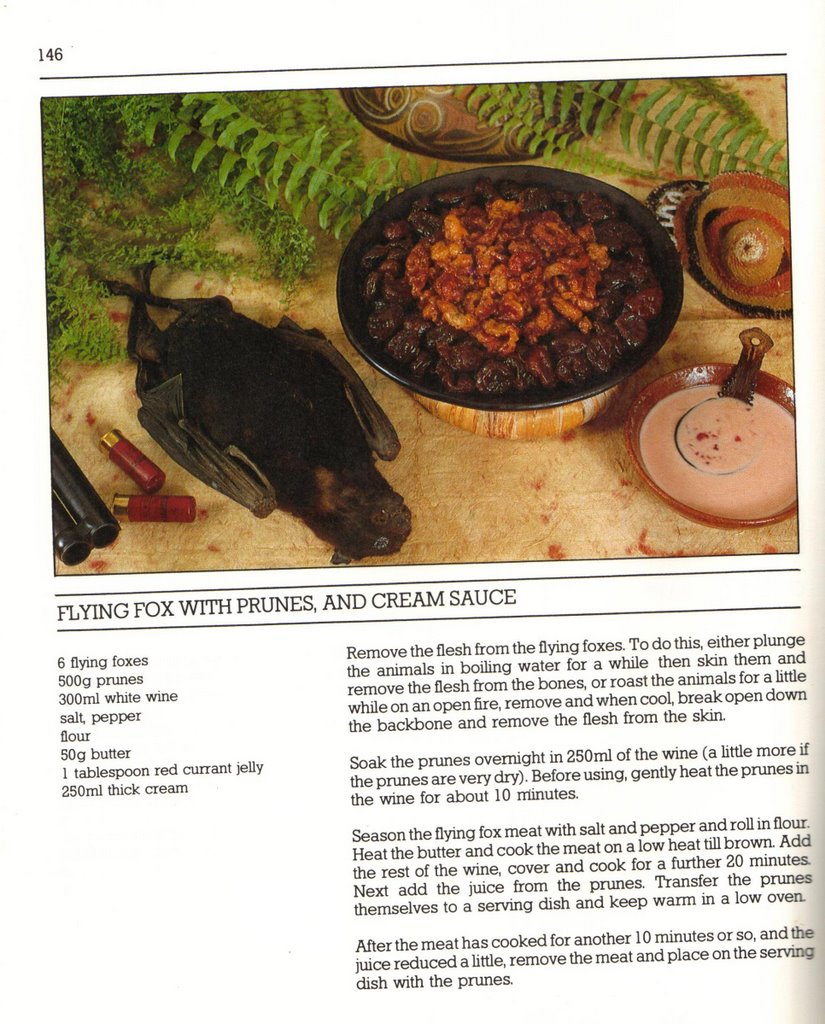
General good things: There's a few things that, with a giant leap of faith in R.J. May, I could have a go at. The recipes mostly look like they were transcribed from the words of a scraggy old betelnut-toothed haus meri from Tabubil who's been cooking for her expat employers for 20 years and is trying to introduce Western techniques to her market ingredients and to move beyond rice-and-Triple Seven-tinned-fish on a Friday night. Clam Chowder, Tapioca Cakes, Beef and Ginger, Grilled Pitpit, Beans in Coconut, Cucumber Soup, Pawpaw Sherbet: I could definitely try them out.
General bad things: Sago Grub Satay. That's right, sago grubs.
3 dozen sago grubs
water
peanut satay sauce
Steam the sago grubs for about ten minutes. I prefer to remove the heads but this is not necessary. Put the grubs on satay sticks (six to a stick) and grill over a charcoal fire for about 5 minutes each side. Coat with the sauce and serve with rice. This is a very rich dish.
Not to mention the Fried Bandicoot, Magani Stew and the Baked Snake.
First, catch your snake.
That has to be the best first step for a recipe, existing anywhere, ever.
The size of the serving, of course, depends on the snake.
Well, of course. OBVIOUSLY.
Lameness factor: Well. I'd give it a 5. It's the lameness that makes most of this book so incredibly appealing.
Overall rating(from 20): 20. It's the flying fox. Who couldn't love that? Em nau!
Wednesday, August 02, 2006
Verdict: The Top One Hundred Dishes of Provence
 Wow, this is a great book. For Frenchiphiles and ex-Provencals like me, it brings back all the fabulous memories of family dinners, gorgeous salads in the local cafe, pastis and aioli. It's also a godsend for cooks who want to expand their French repertoire beyond your salade nicoise and your duck a l'orange. My parents gave me this book when I was sixteen, a budding Frenchy, and just getting into the expanded culinary horizons that this book allows...and encourages. I've used it regularly ever since. My highest rating ever: four thumbs up.
Most-cooked recipe: Onion and Anchovy Tart (Pissaladiere). This is gold. Every French dinner I have, I roll out this damn tart, and everyone goes insane with love for it. Then they kiss my feet and swear allegiance to me, the queen of tarts. Its sweet caramelised onions, the tang of the anchovy, the beautiful op-art effect of a shiny olive studded in each square, the roasting yeast dough that puffs up and gently pulls away from the pan sides, the crisp slicing into squares, the living for days in perfect condition in the fridge.
The recipe, for your oniony enjoyment, is provided. The only change I make is to slice the anchies lengthwise. This used to be so that they would go further, in my poorer days when a jar of them was the price of my train fare to uni for the day. Since then, though, I've come to feel that a whole anch would be overpowering and I've kept with the slicing for this reason.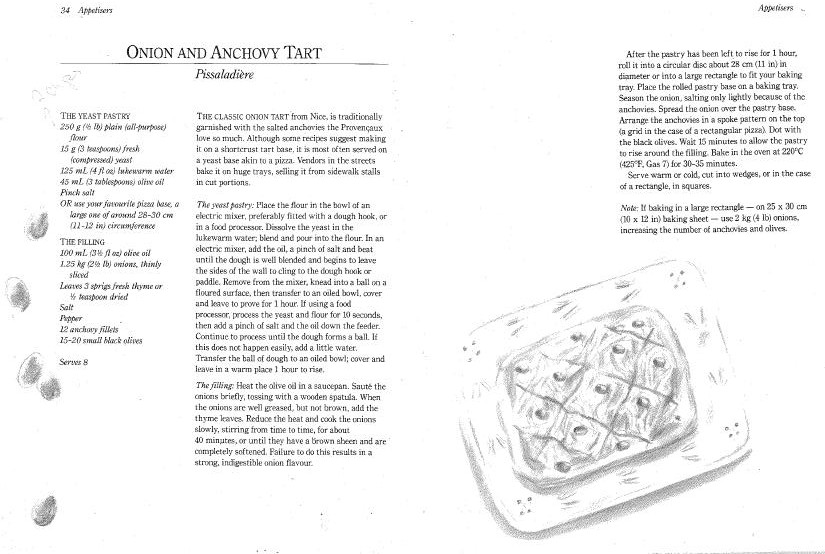
Recipe I haven't tried, but it was one of the reasons I bought the book: Snails, Home Style.
That's right, snails. The recipe calls for "72 snails (2 small cans), drained and well rinsed". I am DEFINITELY going to try this. The snails are fried in breadcrumbs, herbs and ground walnuts.
Also, Rosemary Sorbet....how gorgeous can you get.
Rejected recipe: Duck Breast stuffed with Ham and Sun-dried Tomatoes. This is just me getting picky and looking for something to reject. I'm not big on stuffing meats with other meats. A duck is a precious and interesting thing, and should not have things inserted therein. Really, all the recipes in this book are fab and To Be Tried.
General good things: Just feast your eyes on some of these recipes:
- Saute of Rabbit with Garlic and Thyme
- Bouillabaisse
- Barbecued Tuna with Herbs
- Pizza with Goat Cheese and Pistou
- Aigo Boulido
- Le Grand Aioli
- Fresh Fig and Walnut Tart
- Figs Poached in White Wine and Honey
- Fougasse
- Roast Suckling Lamb with warm Lentil Salad
- Pan Bagnat
- Pine Nut Tart
- Pork Casserole with Capers
- Mussel and Basil Salad
- Naked Raviolis
General bad things: None.
Lameness factor: Zero. This is a great book, and one of my all-time favourites.
Overall rating(from 20): 19.5 (only because of that duck thing).
Monday, June 26, 2006
Verdict: Retro Recipes...Appetizers

"Fab Finger Food From the '50s"!
Wow, retro appeal, alliteration AND correct apostrophe use! Seems like these guys are onto a winner from the start.
Alas.
This is a little cardboard book, the kind you usually see all warped, stained and spit-smeared on toddlers' bookshelves and containing 'A is for apple', and so on.
Actually it's part of a series printed and owned in the UK. Other titles are "Cocktails", "Snacks" and "Desserts". This one is written / compiled by Carla Capalbo and released in 2000.
Technically, it's a winner, cashing in on the super-mega-worldwide appeal for all things kitsch and vintage, including kitchenalia. On that score it wins big. Maybe as something to display, tongue-in-cheek, in your hip kitchen, then yes.
However, on the reality side, the "am I ever going to cook this?" side, I have to report that there are some... issues.
Most-cooked recipe: None. But I probably will. Maybe. Considering there are only ten recipes, the choices are somewhat limited.
Recipe I haven't tried, but it was one of the reasons I bought the book: The only thing I would consider making would be the Stuffed Mushroom Caps. Filling: garlic, parsley, Parmesan and pine nuts, olive oil, seasoning. But then again, I'd probably totally alter the filling so that it didn't contain oil AND cheese AND pine nuts....rich oily overload! I suspect I would make them more like the Chinese stuffed mushrooms you usually encounter at yum cha. But then would I really be making the recipe? Existential dilemma.
Rejected recipe: Oh god, the Tomato Aspic. Clear red jellied soup in a ring mould and filled with various saladal items. The worst thing is the instruction "If you don't have a ring mould, make it in a shallow dish and cut it into squares and triangles before serving". Imagine being faced with a platter of bulky quivering red triangles. Shudder.
General good things: A few funky illustrations and brand-name ads pulled from real recipe books of the 50s. Devilled eggs are a good inclusion, but I'm not sure how retro they are. People I know still make devilled eggs.
General bad things: 1) The instruction to "decorate (above devilled eggs) with olives, capers, pimiento or anchovies, cut into little shapes". And the picture, I swear it's true, has little heart-shaped olives and pimientos, each about the size of a dot and representing the most pointless, labour-intensive and time-consuming task I have EVER imagined doing in the kitchen. Other decorative works- you can see them being appreciated and relevant. Studding a ham. Icing a cake. Making sugar flowers. And so on. But carving an olive??
2) The Herbed Cheese Balls. Served in paper cups. Or, "speared with toothpicks".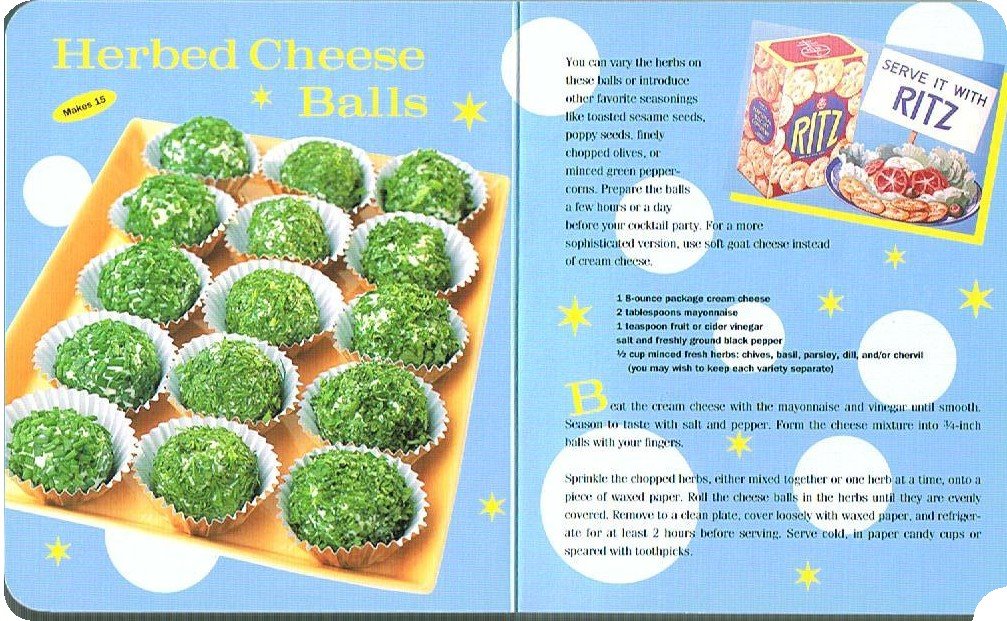
Lameness factor: Suprisingly not too high. After all, the book is designed to be lame.
Overall rating(from 20): 15
Wednesday, June 21, 2006
Verdict: Marie Claire Taste 101
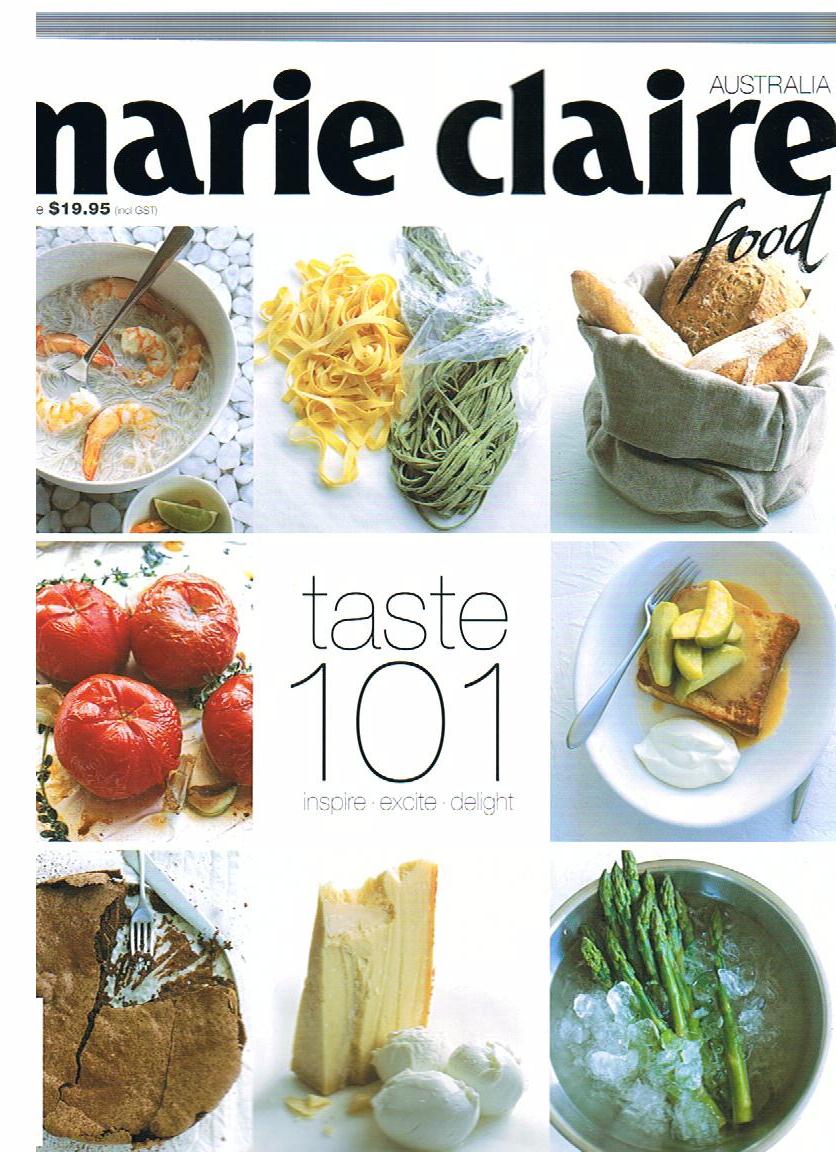
This seems to be the first of a series of newsagent cookbooks, selling for $19.95. Perhaps they are intended to be a sort of course (“Taste 101”?) or perhaps they are to be themed in future editions, and this one is a kind of broad starter pack. This first edition was a gift, and so far nothing from it has been made. But I am going to review it anyway (after several readings) and send down the judgement.
Most-cooked recipe: None so far.
Recipe I haven't tried, but it was one of the reasons I bought the book: Pilaf (p.88). This will be the first thing to be made. Quite legit-looking pilaf, not too culturally bastardised, and containing blanched almonds, pine nuts, cardamon pods, cinnamon stick, currants, cloves and chicken stock. The pictured dish has a nice dry finish to it and doesn’t look soggy. I will be making this to serve with moroccan lamb chops and a cucumber salad.
Rejected recipe: Fish and chips (see below). Also, Red wine risotto (looks very wet and the colour seems to be too pale- and go easy on the sage leaves), Yellow pumpkin curry (so chunky, and one look at the picture at left: blerk) and Potato and truffle pizza. Seems like an excuse to cheapify a truffle if you ask me. Is this how to get the truffle some mass appeal?
General good things: This follows the Marie Claire general pattern: food in sections based around main ingredients and employing a clutterless minimal style. This is of course a good thing, and allows the book to be navigated cleanly and easily. The book also contains desserts, which are varied and interesting (prune cake, anyone?) and has an emphasis on international style (carpaccio of hiramasa kingfish with neil perry’s ginger and shallot oil, paella, tramezzini, black sticky rice pudding).
General bad things: The above internationalising may contribute slightly to its lameness factor. I feel that sometimes with the Marie Claires, national cuisines and tendencies become sterilised and beaten into submission, to become palatable to western appetites. This has the effect of making new food more approachable, breaking down borders, accessing new cultures blah blah, but also implicitly saying that if we are to cook a Spanish paella or make Vietnamese nuoc cham, then we can do it any way we please. I’m not sure if we should look at the food of other cultures this way.
Lameness factor: Medium. What’s the point of telling your target audience of young, hip, aware kitchen freaks to use frozen commercial chips when making fish and chips at home? You can go out for that crap anytime.
I kept looking for a disclaimer (something like: “Of course, handmade and fresh are always best in a hot chip. We specify frozen only for the sake of convenience”) but…no. No, apparently, your soggy par-fried-in-advance white composite vegetable flesh sticks are the ones to go with your gorgeous fresh soda-batter whiting or flathead.
Don’t patronise us, Marie Claire. We know what we’re on about, and you only lameify yourself by doing so.
Overall rating(from 20): 10
Tuesday, June 13, 2006
Verdict: Marie Claire Cooking
The Marie Claire series of cookbooks has been at the forefront of new Australian food style for a decade. Nearly every kitchen I've been in since 1998 has at least one of these poking around somewhere. They are fresh, minimalist and as least-fussy as possible.
I've decided to judge this one first, seeingas it was the first of the series, I've had it for many years and it has served me well, addicting me to Donna Hay and the ABC delicious magazines.
Most-cooked recipe: Chocolate Chip Cookies (p.164). These are easy, quick, don't call for 40 eggs or 3 kilos of sugar. They do however call for a quarter of a kilo of normal eating chocolate (Cadbury's, Lindt, etc). I have been known to double the recipe when taking to a large gathering, but instead of smashing up the chocolate like it says, to just break it into normal squares and secrete one or two inside each giant super-cookie. You love 'em or you hate 'em.
Recipe I haven't tried, but it was one of the reasons I bought the book: Tea-Smoked Baby Salmon (p. 134).
I love tea: I love salmon. Amazing that I have never made this. Doesn't look hard- you cook the salmon and then fire up a wok full of tea, blasting the salmon in a steamer over the top. Smoke, you salmon!
Rejected recipe: None.
General good things: Easy and clear sections for pasta, vegetables, meat, poultry, fruit, baking, etc. Pictures and simple steps for all recipes. No fussy instructions. The kind of cookbook that would make your 90-year-old grandmother think she could whiz up a modern feast for a hip cocktail party, or the kind you could give your cool friend who would never be caught dead cooking but likes to show off a few shiny kitchen props. These recipes won't always be modern and fresh, but they will remain appealing and makeable for a long time.
General bad things: I have issues with over-hyphenated recipe titles: tea-smoked, lemon-fried, wok-fried, pesto-crusted, sugar-grilled and so on. Sounds a little pretentious and mid-90s these days. Although to give Donna credit, she did write it in 1997, and these titles occur rarely in an index of sensibly-named, accurately-listed recipes.
I'd be proud and impressed of any friend who served up one of these funky delicacies.
Overall rating (from 20): 15
Friday, June 09, 2006
Prom Queen
This article from the New York Times talks about the saga that is the American prom ritual.
Apparently girls are spending up to a thousand bucks on the dress, the hair, the makeup, the beauty treatments, the massage, the jewellery, etc.
I don't think that this is an exclusively US phenomenon though. Yes, Aussie girls spend up big for the formal as well, but I think what we are talking about here is the TYPE of girl- whether US, Australian or anything else.
It's only the diva-types, the types who actually have "wardrobes" and personal hairdressers at 17, the types who are in the well-off popular group and who don't have any personal, financial or moral qualms about dropping $400 on a dress that you'll only wear once.
Call me jealous, go ahead. I just think that we are all getting so materialistic, so attached to "things" and physical objects that can be obtained through money alone, that we forget what's real: love, happiness, engaging with the world and making others happy.
But then again, is it madness to expect a 17-year-old NOT to be materialistic? Perhaps it's all a rich tapestry.
Wednesday, May 31, 2006
Roast Chicken and Other Stories
This gorgeous little cookbook by Simon Hopkinson with Lindsay Bareham was given to me by Pete's sister Anna for Christmas 2005. I just can't stop reading it, and re-reading it, and re-reading it...
He divides it up into chapters, or topics for each main ingredient. Some chapter titles: Anchovies, Eggs, Lamb, Eel.
Even stuff like tripe and hake (can you even get that in Australia? Maybe under a different name) sounds great, the way he writes about them.
I want to try his lamb plan: make slits in the joint of lamb and then shove anchovy slices, garlic and rosemary down the slits. I think it would be lovely for a special weekend lunch, served with the super green beans with lemon that we love (can't remember where I found that- possibly in Damien Pignolet's French).
He suggests baby roast potatoes to go with.
Horrible old winter is on the way, but at least we get a chance to go with the beautiful cold-weather dishes for a few months.
Subscribe to:
Posts (Atom)


